

Short answer
Yes, some fresh tissue samples can be transported at ambient temperature, but only under defined and validated conditions. Ambient transport should use a preservation method designed for the tissue, a specified temperature and duration, suitable packaging, and acceptance criteria linked to the downstream assay.
Ambient does not mean leaving tissue on the bench
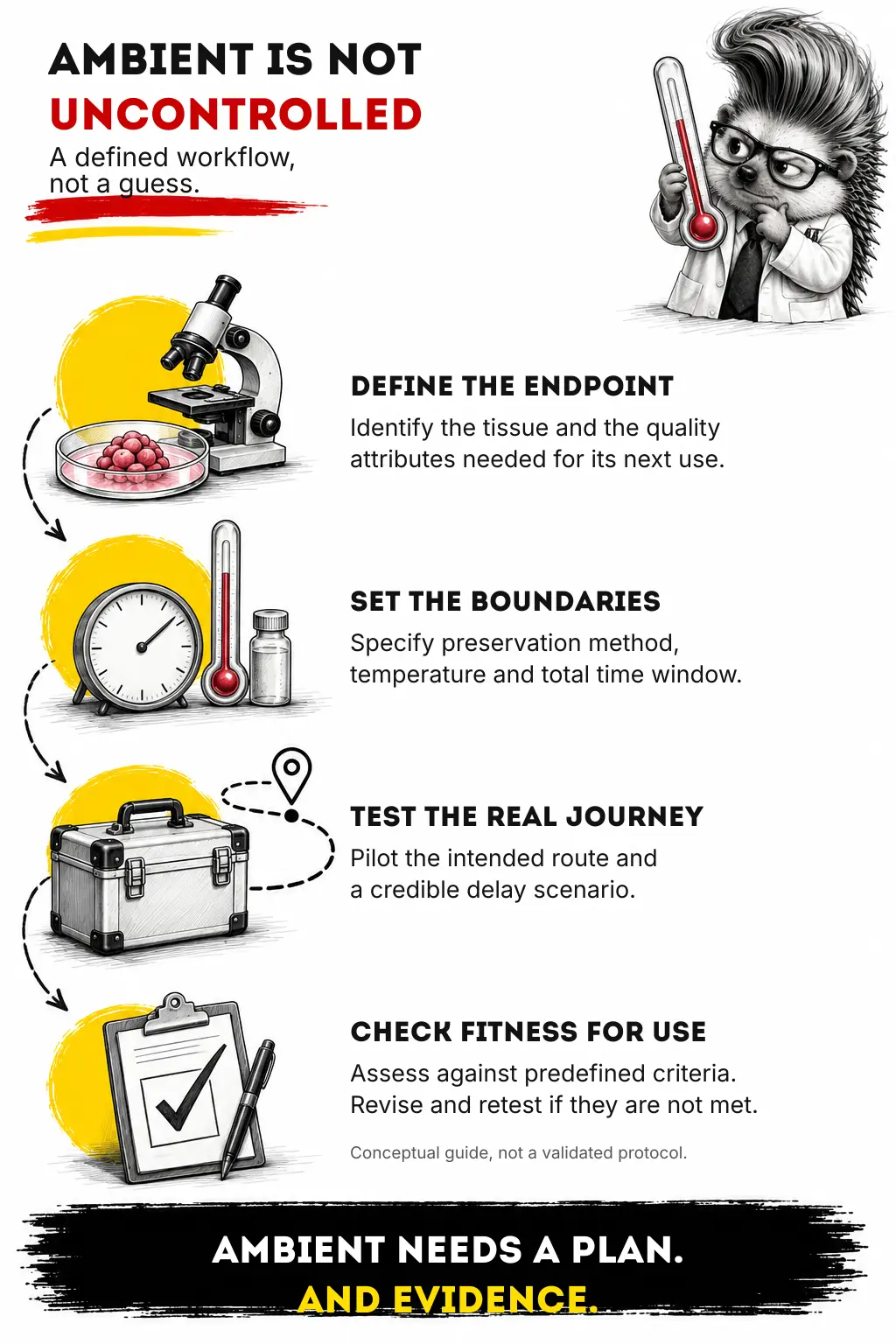
The phrase ‘room-temperature shipping’ can sound worryingly casual. A credible ambient workflow is the opposite. It specifies the preservation chemistry, sample dimensions, container, temperature range, maximum duration, packaging, recovery process and quality checks.
The distinction matters because living tissue left in an unsuitable medium at an uncontrolled temperature is not equivalent to tissue held within a purpose-designed preservation system.
Why consider ambient tissue transport?
Fresh tissue is often collected in one location and processed in another. Maintaining complex refrigerated or cryogenic logistics for every collection may restrict which sites can participate, create weekend pressures and add failure points. A validated ambient option can increase scheduling flexibility and make it easier to move samples from clinic to laboratory without freezing.
The scientific reason must come first. Ambient preservation is useful only if it maintains the qualities needed at the destination. Operational simplicity cannot compensate for a compromised sample.
Which tissues can travel at ambient temperature?
There is no single list that applies to every laboratory because tissue source, size, condition and intended use all matter. Atelerix has generated data in selected primary tissue and cancer tissue applications using TissueReady™ and TissueReady™ PLUS. Reported work includes tested liver, kidney and oesophageal cancer samples, as well as other tissue types described in Atelerix data resources.
This evidence provides a starting point. A tissue not listed should not be assumed incompatible, but nor should compatibility be inferred without a pilot. The correct next step is to compare the proposed preservation condition with the current method using the laboratory’s own readouts.
What should an ambient validation include?
- The actual tissue type and representative sample dimensions.
- The expected shipping window and a credible delay condition.
- Defined lower and upper temperature limits.
- Packaging that protects the container and limits thermal excursions.
- Endpoints such as viable recovery, morphology, staining, molecular quality or function.
- A release and processing SOP for the receiving laboratory.
- Pre-agreed acceptance and deviation criteria.
How TissueReady™ supports ambient workflows
TissueReady™ products use hydrogel encapsulation to create a temporary protective environment around fresh tissue during storage and transport. The sample is released from the gel before downstream processing. TissueReady™ PLUS is designed for biopsies, resections and related fresh tissue workflows, with product sizes selected according to sample dimensions.
In Atelerix cancer-tissue studies, samples stored under defined ambient conditions retained histological integrity and staining profiles, and viable cells were recovered in tested workflows. The relevant data pack and protocol should be reviewed before those results are used to support a new application.
Ambient transport is not a leap of faith. Done properly, it is a controlled method with evidence, boundaries and a plan for what happens when the courier arrives late.
Frequently asked questions
Is ambient tissue transport the same as uncontrolled room-temperature storage?
No. A validated ambient workflow defines the preservation system, temperature range, duration, packaging, recovery method and quality criteria.
How long can fresh tissue remain at ambient temperature?
The window is tissue- and method-specific. Use only a duration supported by compatible evidence or a validation study.
What happens if a shipment exceeds its validated window?
Treat it as a deviation. Review time and temperature records and assess the sample against pre-agreed acceptance criteria before use.
Plan a representative tissue pilot
Explore TissueReady™ PLUS data and protocols, then speak with Atelerix about a representative pilot for your tissue and intended endpoint.
