

Short answer
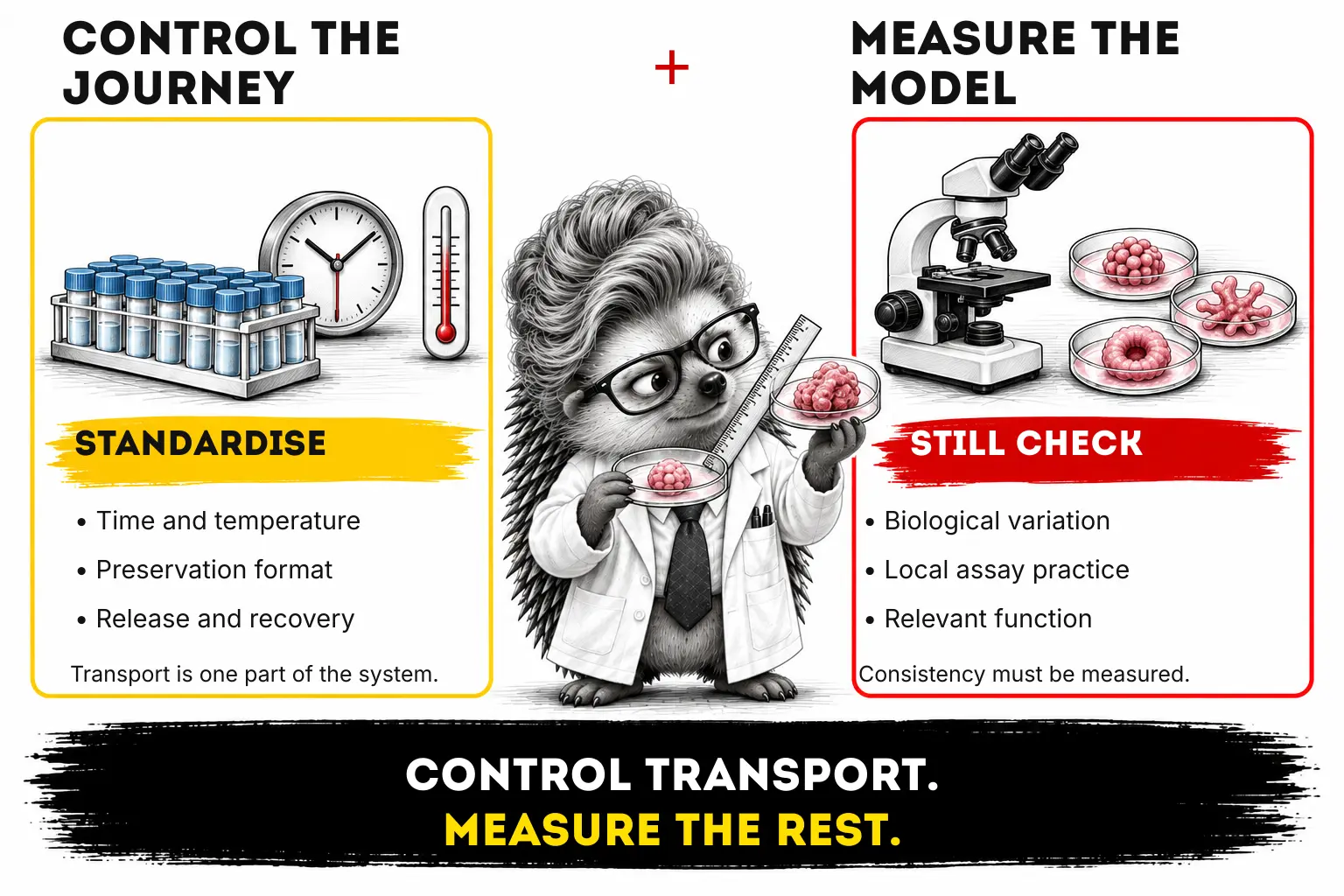
Controlled organoid preservation can support screening consistency by reducing the variation introduced between production and use. It cannot remove intrinsic biological heterogeneity or differences in local assay practice, but it can make transport state, timing and recovery more standardised across sites.
Organoid variability does not begin or end at the incubator
Organoids are valuable because they capture aspects of tissue architecture and function that simpler models may miss. That complexity also creates sensitivity to culture conditions, passage, size, matrix, operator technique and assay timing.
Cross-site research (preprint) has shown that even harmonised organoid protocols can produce site-associated variability. Transport adds another interval in which the models may experience temperature change, movement, media differences and unequal recovery times. Preservation is therefore one part of a larger reproducibility system.
What changes when models are shared between sites?
A multi-site study often asks several laboratories to compare results while giving each site slightly different starting conditions. Models may be cultured locally from a shared protocol, or produced centrally and distributed. In both cases, small timing and handling differences can influence the state of the organoids when the assay begins.
A controlled preservation process can help define that starting state. The sender specifies when models enter preservation. Each shipment uses the same format and procedure. The receiver follows the same release and recovery schedule. Deviations can be recorded and interpreted instead of disappearing into ‘shipping’.
What preservation can and cannot standardise
Preservation can help standardise transport duration, physical protection, arrival format and recovery steps. It may also make centralised production more practical, allowing several sites to receive material from the same manufacturing batch.
It cannot eliminate line-to-line variation, differences in local equipment, assay execution, media preparation or data analysis. Claims of improved reproducibility therefore need to be tied to measured outcomes and a complete study design.
Choosing the right Atelerix format
STORganoid™ is designed for organoids and spheroids transported in vials. WellReady™ is intended for cells and complex models already established in multiwell plates or compatible inserts. The appropriate format depends on whether the receiving site needs to plate the models after release or receive an assay-ready plate.
Atelerix has tested model-specific preservation windows across several organoid types. For example, its WellReady™ liver organoid work evaluated murine iPSC-derived liver organoids preserved for five days at 20°C, with functional assays performed after 72 hours back in culture, while the STORganoid™ storage guide lists tested conditions by organoid type. These are model-specific results, not a universal duration claim.
How to test whether preservation improves consistency
- Distribute material from the same batch to every participating site.
- Use a defined transport and recovery SOP.
- Include an unshipped or established reference control where feasible.
- Measure viability, morphology and the functional endpoint used in the screen.
- Compare within-site and between-site variation across replicate shipments.
- Predefine acceptable variation and how transport deviations will be handled.
The aim is not to claim that preservation makes organoids identical. It is to remove an avoidable source of uncertainty so that genuine biological differences are easier to see.
Frequently asked questions
Why can organoid screening vary between sites?
Sources include biological heterogeneity, culture and passage conditions, matrix, operator technique, assay timing, equipment, transport and recovery.
Can preservation make organoid assays reproducible?
Preservation can control part of the pre-analytical workflow, but reproducibility also depends on production, QC, assay execution and data analysis.
Should organoids be shipped in vials or plates?
Use vials when models will be plated after release and plates when the aim is to distribute an established, assay-ready format. The model and endpoint should determine the choice.
Plan your multi-site organoid study
Planning a multi-site organoid study? Ask Atelerix to help design a pilot that compares transport, recovery and functional performance across the participating sites.
Sources and further reading
Cross-site reproducibility of human cortical organoids (preprint)
