

Short answer
Standardise multi-site organoid distribution by controlling the production batch, preservation state, shipping procedure, recovery schedule, quality controls and deviation handling. Preservation can support the process, but consistency depends on the complete operating model.
Multi-site studies need a distribution system, not just a courier
When several laboratories use the same organoid model, the study may be comparing science and logistics at the same time. If each site receives a different batch, uses a different recovery schedule or begins the assay at a different point, between-site variation becomes difficult to interpret.
A stronger model is to treat organoid distribution as a controlled process with defined inputs, handovers and release criteria.
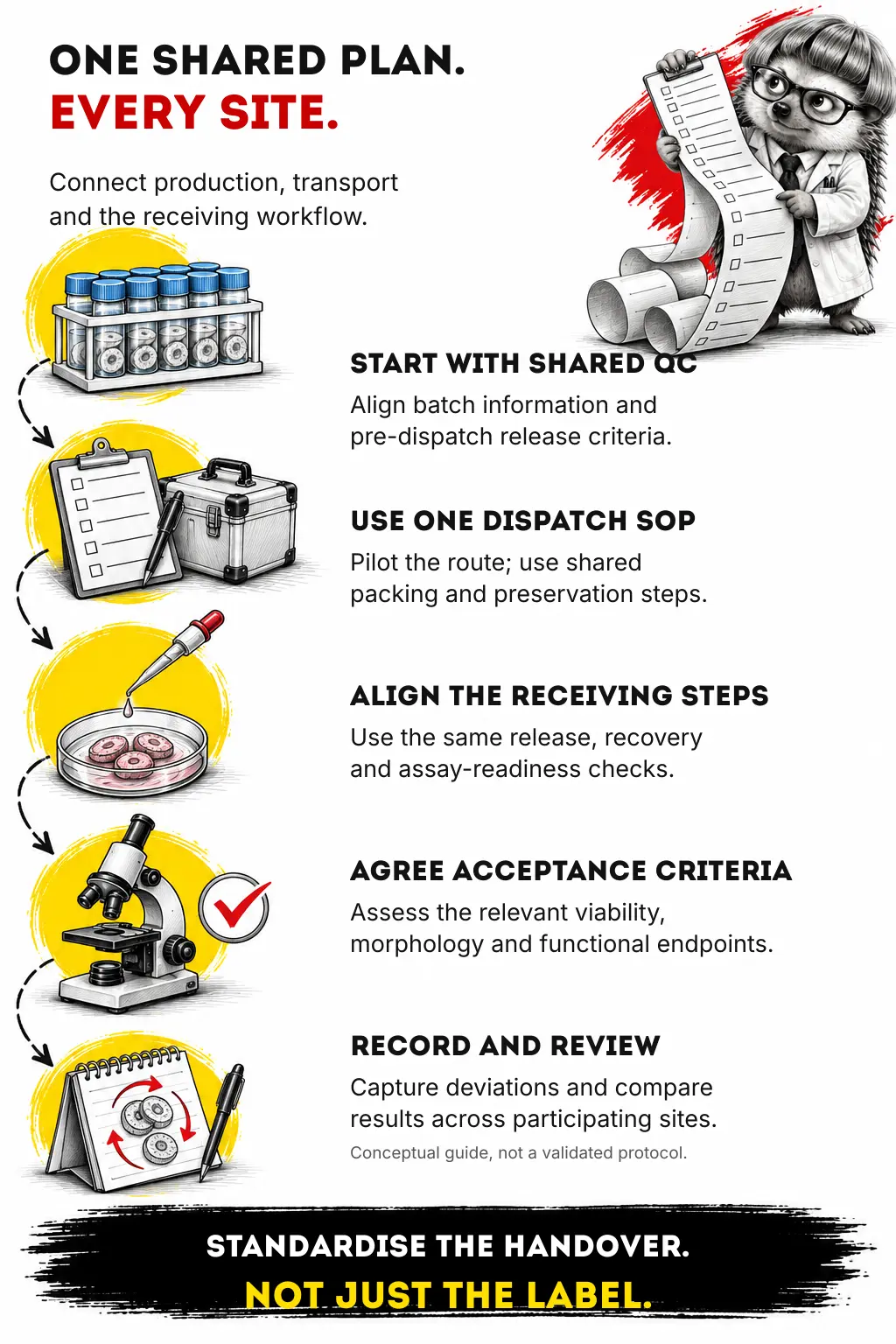
1. Decide what should be centralised
Central production can give participating laboratories material from the same batch and reduce local culture burden. It may be appropriate to distribute organoids in vials for local plating, or to distribute models already established in assay plates. The format should reflect where genuine scientific standardisation is gained and where local flexibility is still needed.
2. Define the shipment unit
Specify organoid type, passage or maturation stage, diameter range, number per vial or well, medium, preservation method and storage window. If these attributes are not controlled before dispatch, the receiving sites cannot be expected to start from equivalent material.
3. Use one preservation and recovery SOP
For vial distribution, STORganoid™ provides a hydrogel-based preservation and release format for compatible organoids and spheroids. For plate-based delivery, WellReady™ can support models in multiwell plates or compatible inserts. Every site should receive the same version of the protocol, training and timing instructions.
Recovery is part of preservation. Define whether the assay begins immediately after release or after a fixed equilibration period. A ‘when convenient’ recovery step is a hidden experimental variable.
4. Set common quality and acceptance criteria
- Pre-dispatch morphology and batch-release measures.
- Temperature and transit-time limits.
- Post-release recovery and viability.
- Model-specific phenotype or architecture.
- A functional benchmark linked to the study.
- Rules for quarantine, repeat shipment or exclusion.
5. Pilot the route before the study
A desktop protocol cannot reveal every handover problem. Run a representative shipment to each site, or at least to the most challenging route, and include a realistic delay. Compare results across sites before committing valuable study material.
Where possible, use replicate shipments from the same production batch. This helps separate transport variation from batch variation.
6. Keep a deviation record
Record dispatch and receipt times, temperature data, packaging condition, operator, release time and any departure from the SOP. This turns ‘the models looked different at Site B’ into an investigable event rather than a scientific shrug.
A well-designed preservation system can make global organoid studies more practical, but the product is only one component. Production, QC, logistics, recovery and assay execution must work as one controlled chain.
Frequently asked questions
Should organoids for a multi-site study be produced centrally?
Central production can reduce batch and protocol variation, but the best model depends on study design, scale, route and the capabilities of receiving sites.
What should be standardised across receiving laboratories?
Shipment unit, preservation procedure, temperature and time limits, release method, recovery interval, acceptance criteria and deviation handling.
Can the same storage time be used for every organoid model?
No. Use model-specific evidence or validation because organoid type, size, medium, maturity and endpoint can affect the suitable window.
Plan your multi-site distribution programme
Building a multi-site organoid programme? Atelerix can help you choose a vial or plate format and design a route-validation study before wider rollout.
Sources and further reading
Cross-site reproducibility of human cortical organoids (preprint)
