

Short answer
Organoids can be protected during transport by controlling their preservation environment, limiting mechanical disturbance, defining temperature and time boundaries, using suitable packaging and standardising release and recovery. STORganoid™ provides a hydrogel-based vial format for validated organoid and spheroid workflows.
A living 3D model has more to lose than a tube of buffer
Organoids are organised, living structures. Their value may depend on spatial architecture, cell-cell interactions, phenotype and function, not viability alone. A model can contain live cells yet still be unsuitable for its intended assay if its structure or performance has changed.
Transport should therefore be designed to protect the properties that make the organoid useful.
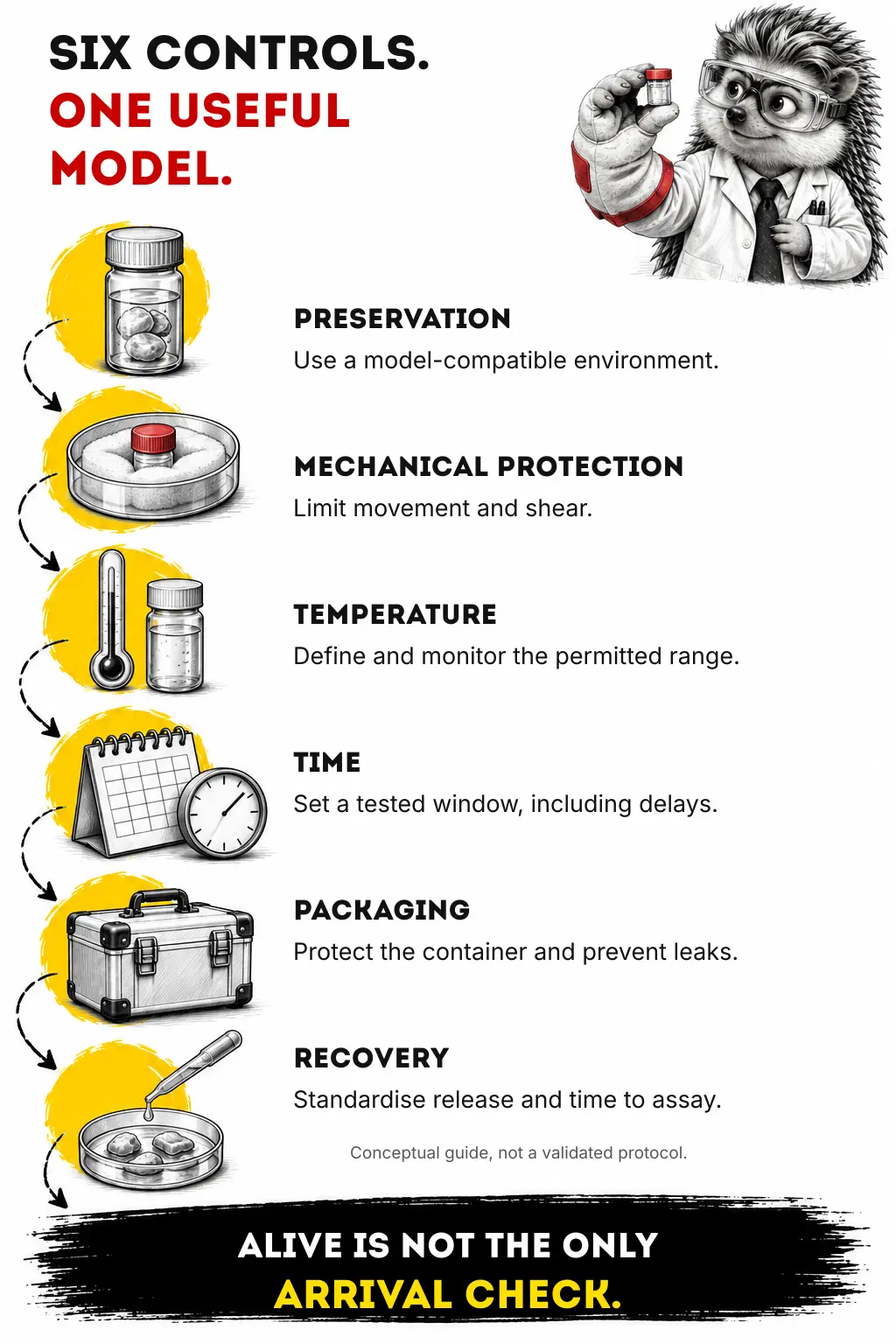
The six controls in a robust organoid shipment
- Preservation environment. Use a medium and preservation system compatible with the organoid type and intended window.
- Mechanical protection. Limit unnecessary movement and shear, particularly for fragile or larger structures.
- Temperature. Define and monitor the permitted range rather than relying on the word ‘ambient’ alone.
- Time. Set the validated maximum from preservation through release, including a delay allowance.
- Packaging. Protect the primary container, prevent leakage and use packaging appropriate to the route and temperature specification.
- Recovery. Standardise gel release, washing, replating or equilibration, and the interval before the assay.
How hydrogel immobilisation can help
STORganoid™ is a vial-based system in which organoids or spheroids are held within a non-crosslinked hydrogel formulation during short-term storage and transport. The model can be combined with its specialised medium, then released using the supplied dissolution buffer.
Immobilisation is intended to provide a more protective physical environment than free movement in a liquid-filled container. It also creates a repeatable preservation and release step that can be written into the shipment SOP.
Use model-specific evidence
Atelerix publishes tested storage conditions for several organoid types, including brain, cardiac, dermal, colorectal cancer, breast cancer, lung cancer and hepatic organoids. The listed times and temperatures differ by model. That variation is scientifically important: it shows why a single headline duration should not be applied across the category.
A new model should be matched to the closest available evidence, then evaluated using its own critical quality attributes. Diameter, number, medium, maturation state and container size may all affect the result.
What should be checked on arrival?
- Container integrity and temperature record.
- Appearance before and after release.
- Organoid recovery and viability.
- Architecture or morphology relevant to the model.
- Phenotypic markers.
- Functional performance after the defined recovery period.
The objective is not simply to deliver something alive. It is to deliver the same useful model the sender intended to ship.
Frequently asked questions
What damages organoids during transport?
Potential risks include unsuitable preservation conditions, temperature excursions, prolonged duration, mechanical disturbance and inconsistent recovery.
Does STORganoid™ work for every organoid type?
Compatibility and storage window are model-specific. Review the published guide and validate new models under representative conditions.
What is the difference between STORganoid™ and WellReady™?
STORganoid™ is designed for organoids and spheroids in vials. WellReady™ is designed for cells and models in multiwell plates or compatible inserts.
Plan your organoid shipment
See the STORganoid™ size and storage guide, then discuss your organoid type, medium, diameter, quantity and journey with the Atelerix technical team.
Sources and further reading
Atelerix STORganoid™ size and storage guide
