

Short answer
Cryopreservation is essential for many organoid banks, but it is not automatically the best method for short-term distribution or assay-ready delivery. Freeze-thaw can add recovery time and model-dependent variation, so the preservation method should be chosen according to duration, format and functional endpoint.
The freezer is not the villain
Cryopreservation enables long-term storage, biobanking and the distribution of many cell and organoid lines. It is an established and valuable tool. The problem begins when freezing is treated as the default answer to every preservation question, including journeys measured in days rather than months or years.
For some organoid models, a freeze-thaw cycle may reduce recovery, alter morphology or require a period of re-expansion before use. The scale of that effect is model- and protocol-dependent. It should be measured, not assumed.
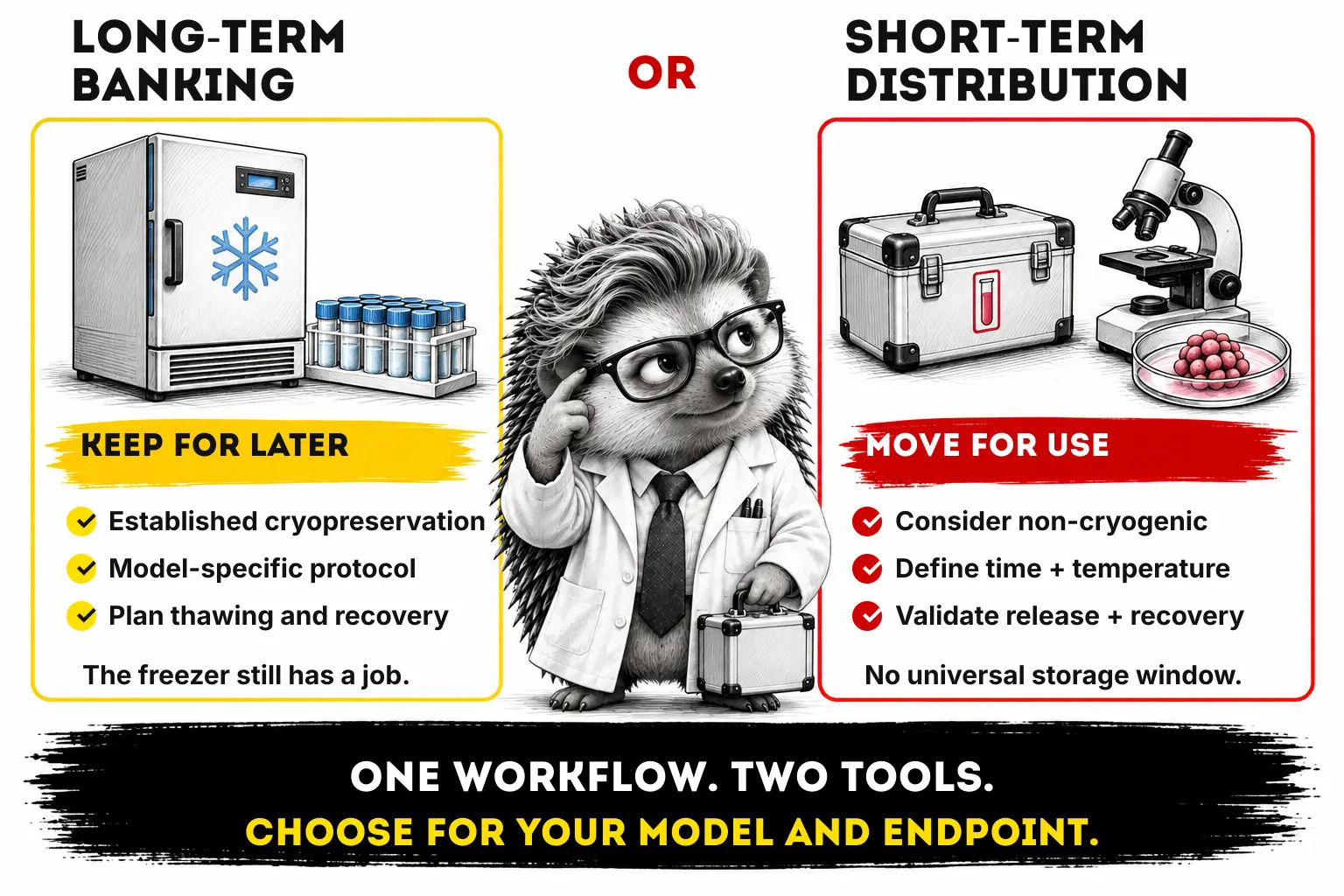
Banking and distribution are different jobs
A bank needs stability over long periods and accepts that the material will be thawed and recovered before use. A distribution workflow may need models to arrive in a state that can enter an assay quickly. Those goals lead to different trade-offs.
If organoids are frozen for a short shipment, the receiving site may need specialist thawing expertise, recovery media and additional culture time. That can introduce scheduling differences between laboratories. If the models are instead preserved temporarily without freezing, the workflow may avoid a thaw and shorten the route back to use.
When should a non-cryogenic option be considered?
- The required preservation window is measured in days rather than long-term storage.
- The organoids need to retain architecture or functional readiness through the journey.
- The receiving site would benefit from reduced thawing and recovery work.
- Central production and repeat distribution are part of the operating model.
- The specific organoid type has compatible evidence or can be validated under the intended conditions.
Vials, plates and the Atelerix options
STORganoid™ is designed for short-term preservation of organoids and spheroids in vials. The formulation can be combined with the user’s specialised medium, and tested storage conditions are listed by organoid type. WellReady™ is used when organoids or other models are already established in multiwell plates or compatible inserts.
Atelerix data include organoid-specific examples at ambient or hypothermic temperatures, but the tested window varies by model. The safe claim is not ‘organoids last for X days’. It is ‘defined organoid models have been tested for defined periods under defined conditions’.
How to compare freeze-thaw with short-term preservation
Run a side-by-side study using the intended shipping duration and receiving workflow. Measure recovery yield, viability, morphology, marker expression and, most importantly, the model’s relevant function. Include the time and labour needed to return the models to an assay-ready state.
The result may be that cryopreservation remains the best choice. It may be that short-term non-cryogenic preservation is better for distribution while freezing remains the best option for the bank. A scientifically mature workflow can use both.
Frequently asked questions
Do organoids always survive freezing and thawing?
No method gives a universal outcome. Freeze-thaw recovery depends on organoid type, protocol, cryoprotectant, cooling and thawing conditions, and the endpoint being measured.
Is non-cryogenic preservation a replacement for organoid banking?
No. It is primarily a short-term storage and distribution option. Cryopreservation remains important for long-term banking.
How should the two methods be compared?
Compare them under the intended workflow using recovery, morphology, phenotype, function, time to assay readiness and operational burden.
Choose a preservation format for your workflow
If you need to move organoids between sites without adding an unnecessary freeze-thaw cycle, review STORganoid™ for vial workflows or WellReady™ for plate-based models.
