
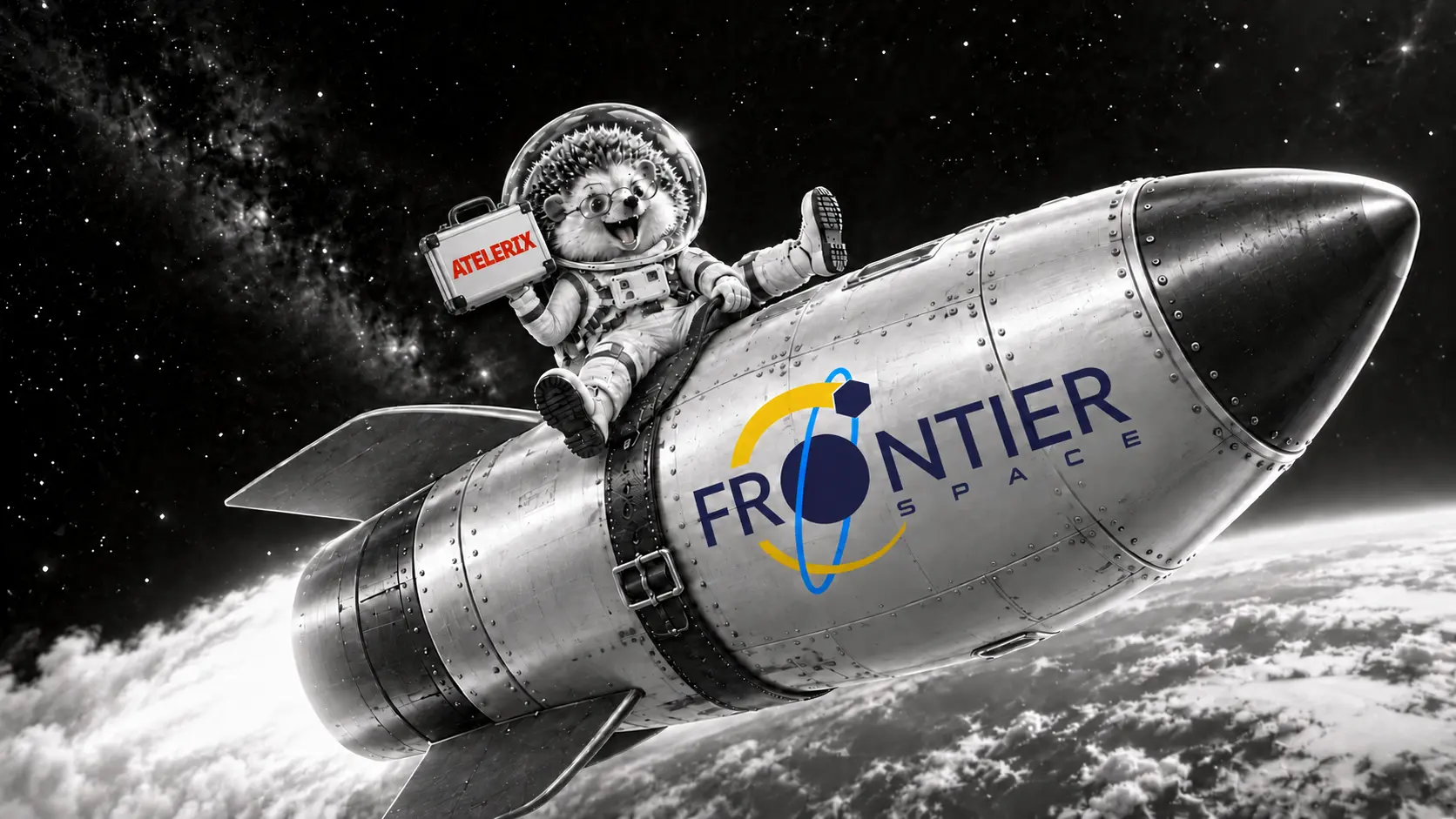
- Collaboration to validate Atelerix’s technology for biological sample transport, reducing weight-related mission costs for high-quality microgravity research
- Two-year memorandum of understanding to cover preservation and transport of suspended mammalian cells, organoids and organ-on-chip models
- Partnership creates a pathway to commercial adoption of Atelerix’s patented preservation technology in space biotechnology, with launch opportunities targeted for 2027
Newcastle, UK, 27th October 2026: Atelerix, a biotech company revolutionising cell preservation and biological transport with its pioneering hydrogel encapsulation technology, today announced a partnership with Frontier Space, a UK based space biotechnology company building platform technology for in-orbit R&D and biomanufacturing. Under the two-year memorandum of understanding (MoU), the companies will validate Atelerix’s alginate hydrogel encapsulation technology for preserving biological samples during microgravity research missions, improving sample quality and reducing payload mass and associated costs.
Frontier Space provides in-space R&D services to accelerate biotechnology research by exploiting the improved protein crystallisation, 3D cell culture, and expedited ageing associated with microgravity conditions. Transporting biological samples to, within and back from space typically requires cryopreservation, adding operational complexity and risk, as well as increased payload-related mission costs.
The collaboration will assess Atelerix’s patented alginate hydrogel encapsulation technology for ambient temperature preservation and transport of suspended mammalian cells, organoids and organ-on-chip models. By potentially reducing reliance on cold-chain logistics, the partnership aims to address key bottlenecks for microgravity research. This includes simplifying sample transport and handling, reducing preservation-related payload mass and risk, and assessing sample integrity and suitability for post-flight analysis.
As part of the agreement, Atelerix will provide preservation products, protocols and technical support for agreed testing projects, while Frontier Space will identify relevant sample and payload use cases and support the design, integration and execution of validation work within its in-space R&D capabilities. The parties are targeting launch opportunities throughout 2027, with successful validation informing the direction of future commercial projects in the growing field of space biotechnology.
Alastair Carrington, CEO, Atelerix, commented: “Working with Frontier Space gives us a clear route to test the benefits our approach can bring to microgravity research, removing the cost and complexity of cold chain transport and enabling scientists to access higher quality samples for post-mission analysis. We believe Atelerix is well placed to support this new frontier of biotechnology and become the preferred preservation solution for those looking to harness this unique environment to accelerate their research.”
Dr Aqeel Shamsul, CEO, Frontier Space, said: “In-space R&D offers opportunities to investigate biological processes and therapeutic candidates under conditions that complement research on Earth to improve treatment for patients. Making these missions more practical and cost-effective is important to expanding access to pharmaceutical research in orbit. Through our collaboration with Atelerix, we will assess whether its preservation technology can reduce reliance on bulky cryogenic storage while maintaining the sample quality required for post-flight analysis. This is an important step in evaluating practical solutions for future space-based research and biomanufacturing. We anticipate that we can save up to $30,000 in launch costs by removing the need for bulky cryogenic storage, ultimately making microgravity research accessible to more researchers than ever before.”
