
Start with the destination, not the shipping box
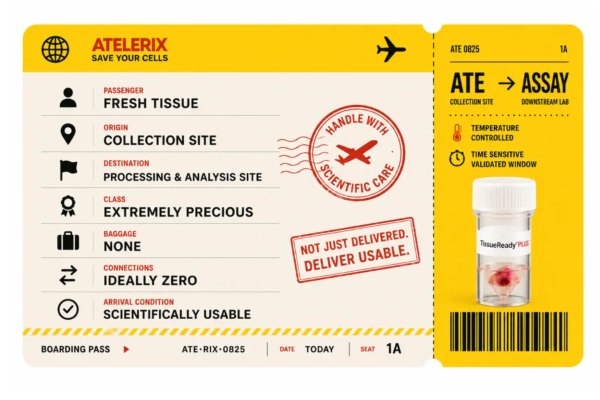
‘Sample integrity’ is too vague to validate. A pathology workflow may prioritise morphology and staining. A model-generation workflow may need viable cell yield and phenotype. A molecular study may depend on RNA quality. The preservation plan should be designed around the endpoint that must survive the journey.
Write those endpoints down before choosing the container, temperature or courier. Otherwise, a shipment can be operationally successful while the sample is scientifically unusable.
A seven-step tissue transport checklist
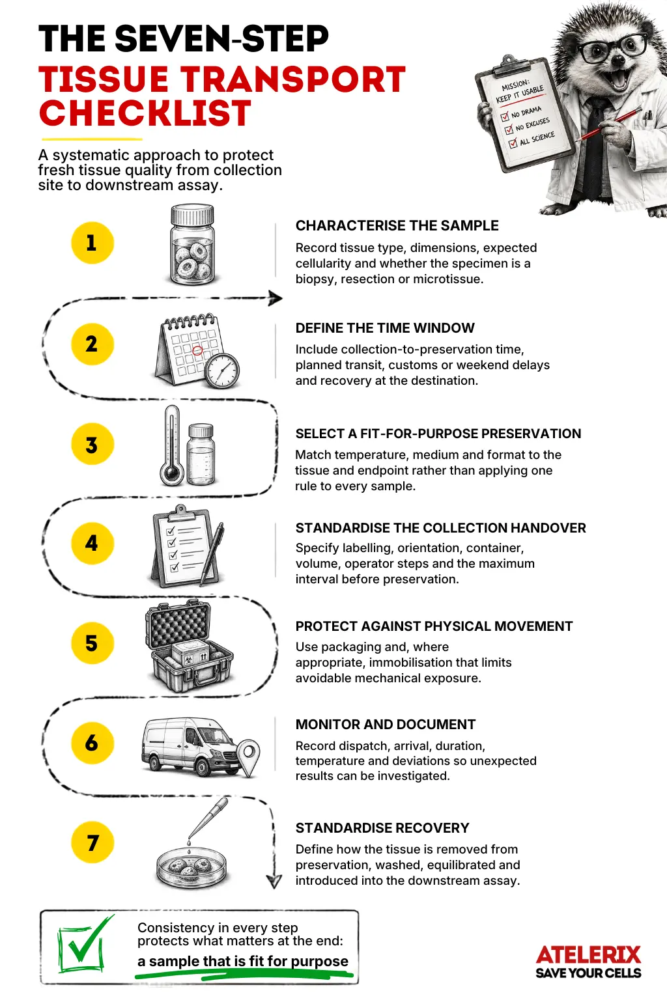
- Characterise the sample. Record tissue type, dimensions, expected cellularity and whether the specimen is a biopsy, resection or microtissue.
- Define the time window. Include collection-to-preservation time, planned transit, customs or weekend delays and recovery at the destination.
- Select a fit-for-purpose preservation condition. Match temperature, medium and format to the tissue and endpoint rather than applying one rule to every sample.
- Standardise the collection handover. Specify labelling, orientation, container, volume, operator steps and the maximum interval before preservation.
- Protect against physical movement. Use packaging and, where appropriate, immobilisation that limits avoidable mechanical exposure.
- Monitor and document. Record dispatch, arrival, duration, temperature and deviations so unexpected results can be investigated.
- Standardise recovery. Define how the tissue is removed from preservation, washed, equilibrated and introduced into the downstream assay.
Build in a delay scenario before the real shipment
A workflow validated only for an ideal next-day delivery is not validated for real logistics. Couriers miss connections. Collections happen late on Fridays. Customs may ask a question that no one anticipated. A sensible pilot includes the expected transit time and at least one credible delay condition.
The objective is not to prove that a sample can tolerate anything. It is to define the operating window in which the required quality attributes remain acceptable.
Where hydrogel preservation can fit
Atelerix TissueReady™ products are designed to support non-cryogenic storage and transport of fresh tissue. The hydrogel temporarily holds the sample in a defined preservation environment, after which it can be released for processing. TissueReady™ PLUS is intended for biopsies, resections and related primary tissue workflows where ambient preservation may offer greater scheduling and transport flexibility.
Published Atelerix evidence includes tested cancer-tissue workflows in which histological integrity and staining profile were retained under defined conditions, with viable cells recovered after longer storage periods. This is encouraging evidence, not permission to generalise across every tissue. A new application should be checked against the relevant data pack and validated using its own acceptance criteria.
What should be measured after transport?
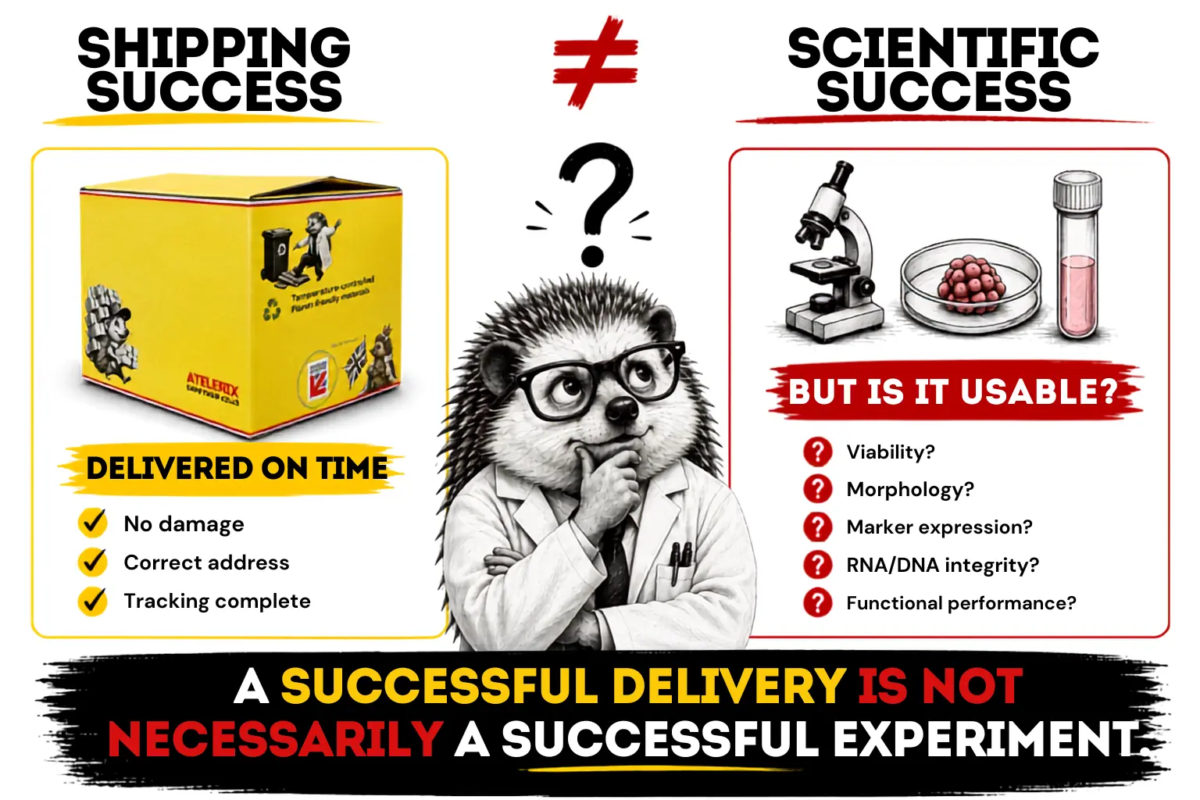
Choose measures that predict whether the sample is fit for use. Depending on the workflow, these may include:
- viable cell recovery and post-recovery growth
- tissue morphology and architecture
- immunohistochemical or flow-cytometry marker expression
- RNA or DNA yield and integrity
- functional assay performance
- comparison with a fresh or established transport control.
The best transport process is not the one with the most impressive packaging. It is the one that produces a repeatable, usable sample at the other end.
Frequently asked questions
What is the most important factor in fresh tissue transport?
The most important factor is alignment between the preservation process and the downstream endpoint. Time, temperature, sample size, mechanical protection and recovery all contribute.
How should laboratories prepare for shipping delays?
Validate a realistic delay condition, document a maximum operating window and define what the receiving laboratory should do if that window or temperature range is exceeded.
How do you know whether transported tissue is still usable?
Use pre-agreed acceptance criteria based on relevant measures such as viability, morphology, marker expression, molecular integrity or function.
Ask Atelerix to help map your tissue type, shipping window and downstream endpoint to an appropriate pilot validation. Eligible new customers can also review the Atelerix Money-Back Guarantee, with terms applying.
Keep Atelerix in your Google results
Follow Atelerix as a Preferred Source to see more of our science, research and biosample preservation updates across Google Search.
