Environmental responsibility
A lighter footprint
for living biology.
Atelerix develops preservation technologies intended to make the storage, transport and use of fresh biological materials simpler, more resilient and less resource-intensive.
Lower impact only counts when the biology still works.

Our approach
Five principles.
No green gloss.
01
Science first
Environmental benefit matters only when biological quality is preserved for the intended application.
02
Only necessary cooling
We aim to avoid energy-intensive temperature control where the validated workflow does not require it.
03
Reduce transport-related waste and failure
Atelerix enables standard shipping with minimal packaging, avoiding bulky insulated boxes, heavy dry-ice loads and excess polystyrene. Longer validated transport windows can also reduce the risk of sample loss, disposal and repeat shipments when delays occur.
04
Enable wider access to science
More robust transportation can widen access to biological models, specialist analysis and collaborative research.
05
Measure, model and disclose
We distinguish recorded outcomes, calculated estimates and stated assumptions, so environmental claims remain transparent and proportionate to the evidence.
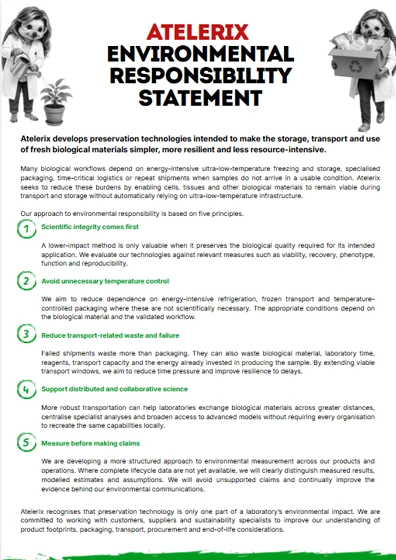
Download the full statement
Keep the evidence
to hand.
The statement includes Atelerix’s five environmental principles, the recorded cell-transport outcomes, scenario assumptions and the transparent calculation method.
Real-world cell transport case study
The shipment was delayed.
The science wasn’t.
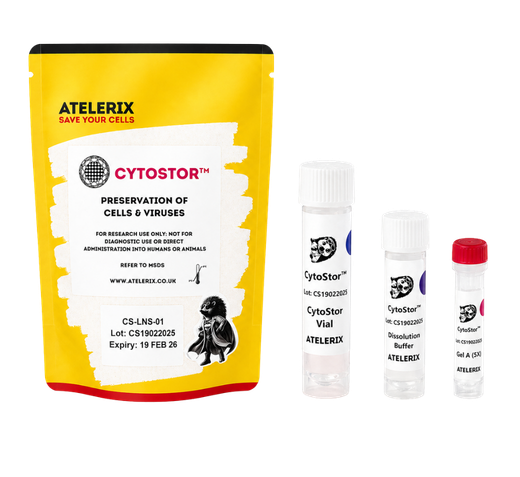
o2h used CytoStor™ to support the ambient shipment of multiple cell lines from its UK laboratory to a sister site in Ahmedabad. The shipment encountered an extreme heat event and customs delay, extending transit to approximately ten days.


Case-study workflow
Planning an ambient cell shipment? Review CytoStor™ and discuss the validated conditions required for your material.
The outcome
Resilience measured
in results.
The cell lines were recovered with little observed loss of viability, placed into immediate use and used to reproduce the required assay. The CytoStor™ route was reported to cost approximately £320, compared with an estimated £1,750 for a conventional dry-ice route.
Transparent scenario modelling
Show the working.
The available records do not include confirmed gross shipment weights, dry-ice quantity, packaging composition or courier-specific freight data. This is therefore a transparent scenario estimate, not a verified lifecycle assessment or audited product carbon footprint.

Estimate shipment weights
Dry-ice comparator
Assumed gross weight: 25 kg
 Ambient CytoStor™ route
Assumed gross weight: 5 kg
Both scenarios use the same four-vial biological shipment. The central scenario assumes an 80% reduction in gross shipment weight.
Convert kilograms to tonnes
5 kg ÷ 1,000 = 0.005 tonnes
Calculate freight activity
Dry-ice comparator
0.025 × 6,874 = 171.85 tonne-km
CytoStor™ route
0.005 × 6,874 = 34.37 tonne-km
Apply an illustrative freight factor
The 0.60 factor is illustrative and must be replaced by the applicable value from the UK Government 2026 greenhouse-gas conversion-factor dataset once the courier route and service type are confirmed.
Dry-ice estimate
171.85 × 0.60 = 103.11 kg CO₂e
CytoStor™ estimate
34.37 × 0.60 = 20.62 kg CO₂e
Compare the scenarios
Central scenario: approximately 82 kg CO₂e lower weight-based air-freight emissions, equivalent to an indicative 80% reduction under the stated assumptions.
Conservative47%
15 kg comparator
8 kg CytoStor™
Central80%
25 kg comparator
5 kg CytoStor™
Upper91%
35 kg comparator
3 kg CytoStor™
Evidence classification
What we know.
And what we do not.

Recorded
- Journey and destination
- Four vials shipped
- Shipment costs
- Approximate transit time
- Heatwave and customs delay
- Biological and assay outcome
Calculated
- £1,430 estimated cost saving
- 81.7% estimated cost reduction
- Cost per vial
- Freight tonne-kilometres
- Scenario-based CO₂e estimates
Assumed
- Gross package weights
- Dry-ice quantity
- Air-freight service type
- Freight conversion factor
- Packaging composition
Not included
- Product and packaging manufacture
- Dry-ice production and delivery
- Road collection and final mile
- Indirect routing
- Disposal and end of life
- Replacement cell production
The impact of shipment failure
A failed shipment wastes more than packaging.
It may require replacement cell culture, more plastics, media and reagents, repeated staff activity and a second international shipment.
This is an illustrative avoided-risk scenario. There is no evidence that the alternative shipment would definitely have failed.

CO₂e in further weight-based air-freight emissions for one modelled repeat dry-ice shipment.
A more resilient route
Could your workflow
travel lighter?
Appropriate conditions and preservation durations depend on the cell type, workflow and validated intended use. Speak with Atelerix about your material, route and validation requirements.
Carbon figures are scenario-based estimates developed from the information currently available. Final figures should be recalculated using confirmed packed shipment weights, actual routing and the applicable UK Government greenhouse-gas conversion factor.