

Fresh tissue does not stop being biological when it enters a box
A tissue sample may have left the patient, but its cells remain metabolically active. Oxygen and nutrient availability change, waste products accumulate and cellular stress responses continue. At the same time, the sample may experience delays, vibration and temperature variation that were never part of the experimental plan.
These are pre-analytical variables: changes introduced before the sample reaches the assay. The US National Cancer Institute has built a dedicated Biospecimen Pre-analytical Variables programme because collection, processing, preservation and transport conditions can influence the molecular profile of biospecimens. If those conditions vary between samples or sites, the analytical result may partly reflect the journey rather than the underlying biology.
What causes fresh tissue quality to decline during transport?
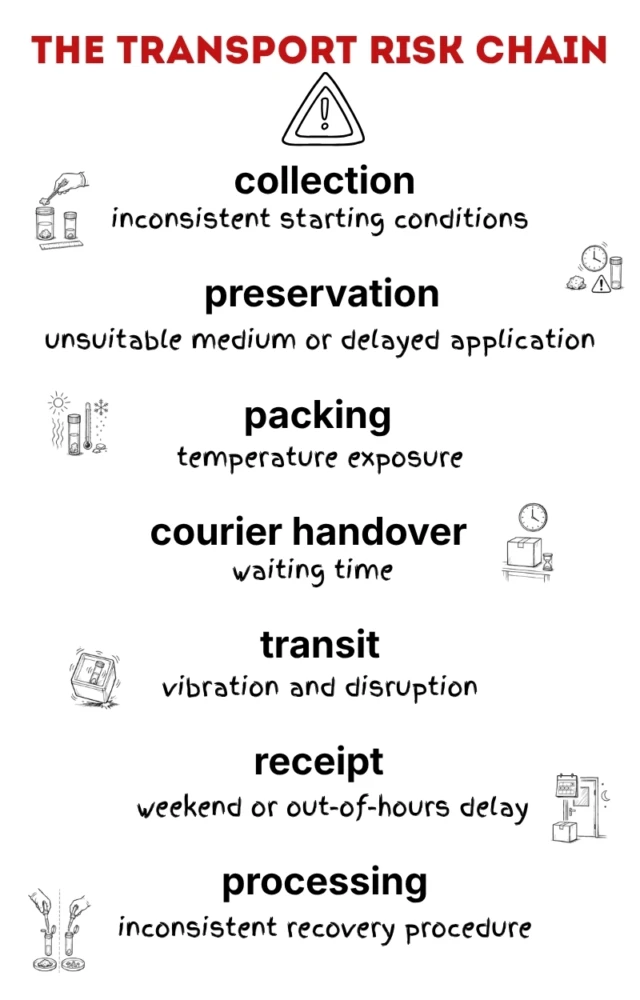
The relative importance of each risk depends on the tissue and the downstream endpoint, but five variables recur:
- Longer delays increase the opportunity for metabolic stress, cell death and changes in molecular markers.
- A specified temperature range can slow damaging processes, but excursions or poorly matched conditions may still affect quality.
- Preservation environment. The surrounding medium must suit the tissue, the intended duration and the required endpoint.
- Mechanical exposure. Movement can damage fragile tissue architecture or complex three-dimensional models.
- Process variation. Different collection containers, operators, packing methods and recovery times create additional sources of inconsistency.
Why ‘keep it cold’ is not a complete preservation strategy
Cold-chain control is valuable in many workflows, but temperature is only one part of sample preservation. A shipment can remain within a nominal temperature range and still arrive late, mechanically disturbed or biologically compromised. Conversely, ambient transport is not the same as uncontrolled transport. It requires a defined preservation system, an appropriate temperature window, validated packaging and clear acceptance criteria.
The right question is therefore not simply, ‘Was it cold?’ It is, ‘Did the process maintain the properties required for the next step?’ Those properties may include viable cell recovery, morphology, histological integrity, marker expression, RNA quality or functional performance.
A more controlled approach to fresh tissue transport
Atelerix develops hydrogel-based preservation systems that temporarily immobilise fresh biological material during storage and transport. TissueReady™ and TissueReady™ PLUS are designed for primary tissue, biopsies, resections and related tissue formats. The sample is encapsulated for the defined transport window, then released from the gel for downstream processing.
This creates an alternative for workflows where fresh tissue needs to travel without freezing. It does not remove the need for validation. Tissue type, size, temperature, duration, medium and downstream assay must all be considered together. Atelerix data for TissueReady™ PLUS include maintenance of histological integrity and staining profile in tested cancer tissue workflows, alongside recovery of viable cells after defined storage periods. Those findings should be applied only to comparable, validated conditions.
What should a laboratory validate before shipping fresh tissue?
- Define what ‘quality’ means for the receiving assay.
- Test the expected journey and a realistic delay scenario.
- Measure relevant endpoints before and after transport.
- Record temperature, duration, packaging and deviations.
- Set acceptance criteria before the first live shipment.
Fresh tissue transport is not merely a courier task. It is part of the experimental method. Treating preservation as a controlled pre-analytical step can protect both the sample and the confidence placed in the data it produces.
Frequently asked questions
Why do fresh tissue samples degrade during shipping?
A major cause is dysregulated ion and water transport leading to cellular oedema, lysis and swelling of the extracellular matrix. Living tissue can also continue to respond to time, temperature, nutrient availability, handling and mechanical stress after collection. The relative contribution of each factor depends on the tissue type and intended downstream analysis.
Does fresh tissue always need to be frozen for transport?
No. Freezing is suitable for some long-term storage and transport workflows, but fresh or short-term non-cryogenic preservation may be preferable when viable cells, intact architecture or rapid recovery are required.
Can tissue be transported at ambient temperature?
Potentially, if a suitable preservation system, temperature window, journey duration and downstream endpoint have been validated for that tissue.

Planning a fresh tissue workflow? Speak with Atelerix about your tissue type, journey and downstream readouts, or explore the TissueReady™ and TissueReady™ PLUS evidence and protocols.
Keep Atelerix in your Google results
Follow Atelerix as a Preferred Source to see more of our science, research and biosample preservation updates across Google Search.
